
About | Events | Meet us | Contact | Join
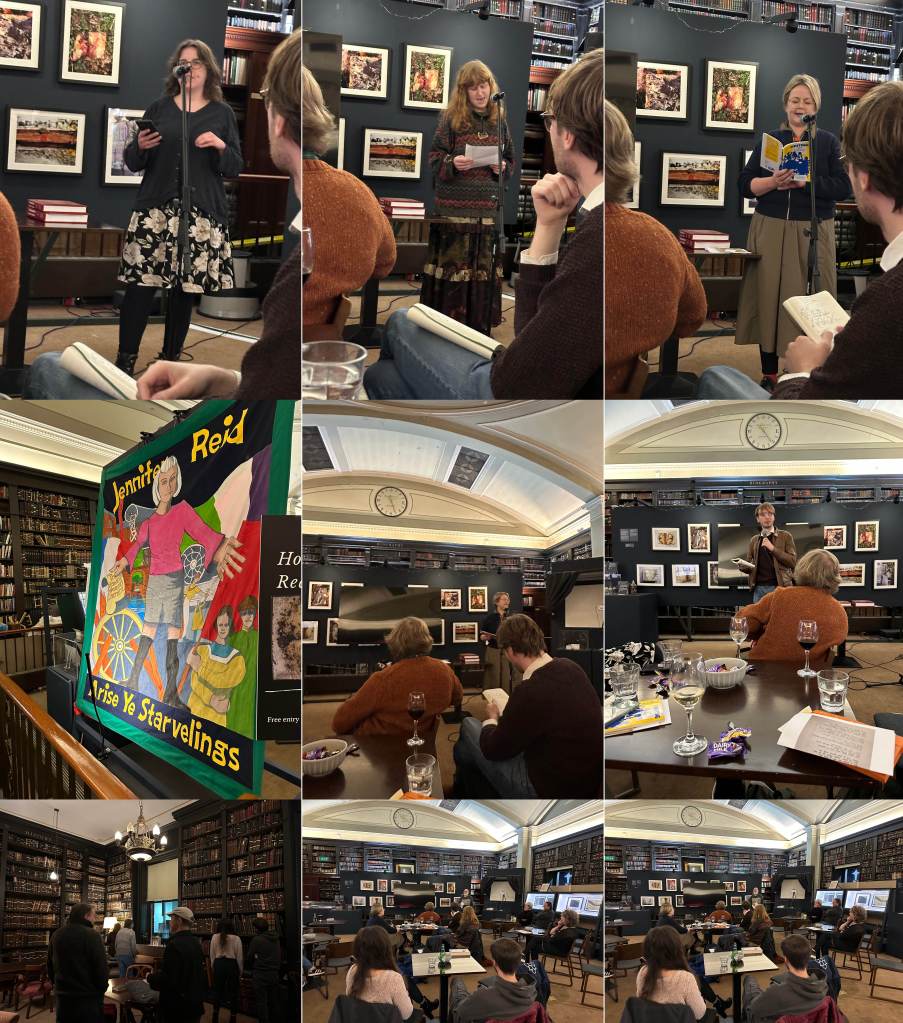
BLOG: History open mic night photos
HL+ Network Northern Ireland, Belfast 2025
Kathy Davies & Mike Reeve Co-Chairs
In late September, co-Chairs Mike Reeve and Kathy Davies led a networking, careers, and public history event in Belfast for the HL+ community. After a welcome coffee morning, Dr Sophie Cooper gave a lunchtime lecture that charted her research and professional trajectory from early career historian to a Senior Lecturer in Liberal Arts at Queens University. Sophie’s talk was an open, honest, and insightful account of real value to ECRs pursuing an academic career. She did not shy away from the challenges that late-stage PhD and postdoctoral historians face, but it was a refreshingly positive yet practical reflection on her own career development. Thank you, Sophie, from the HL+ network.
In the afternoon we visited Ulster Museum for a tour of The Bell Archive Exhibition, which showcases photography by James Bell. Developed in partnership with the Belfast Archive Project, the exhibition documents life along the west coast of Ireland in 1950. The fantastic curators at Museums Northern Ireland then gave us a tour of Akihiko Okamura: The Memories of Others, an exhibition of artworks by Akihiko Okamura, a Japanese photographer who documented Ireland, North and South, during the Troubles. The photographs of milk bottles as representative of everyday violence within the context of conflict in Northern Ireland was a particular point of interest and discussion for the group. The exhibition is on display at Ulster Museum until January 2026.

Milk bottles on doorstep, Ireland, 1970s. ©Estate of Akihiko Okamura / ©佐藤純子
In the evening, new and longtime members of the HL+ community convened at The Pavillion pub for the first ever HL+ Open Mic Night in Belfast. Our fantastic host, Dr Maurice Casey, kicked off a night of fast history talks with ‘Hot History Takes: Too Spicy for Social Media?’, which included the fantastic quip – ‘If history is written by the winners, why are all my colleagues such losers?’. The shared laughter was an excellent start to several hours of shared fun. Contributors included Julie Mathias, Emma Southan, and Susie Deedigan, and talks covered topics from tourism in the Roman Empire to Irish revolutionary women. The evening was a really nice way to demonstrate the breadth and depths of ECR knowledge and the value of coming together in forums beyond our own fields of expertise. Thank you to everyone who put themselves in the spotlight – it’s not easy!
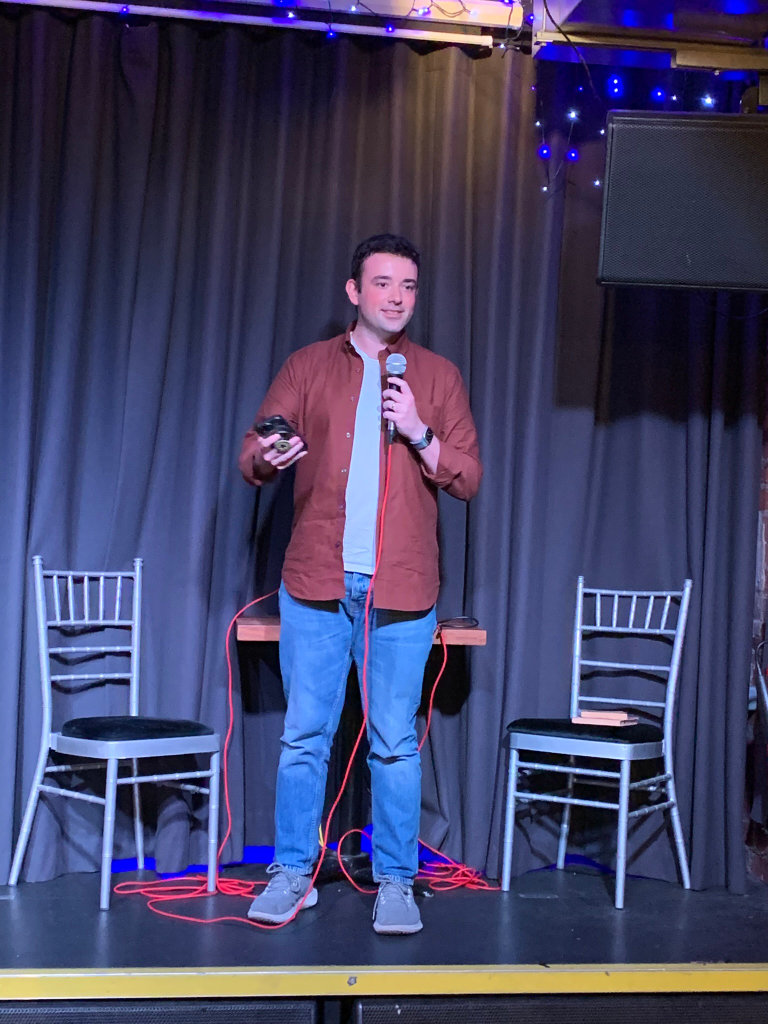
Dr Maurice Casey open mic quip: ‘If history is written by the winners, why are all my colleagues such losers?’
Applications are now open for our Northern Ireland Ambassador, whose primary role will be to lead this event and similar event across NI in the future. If you are interested in joining the HL+ committee, please get in touch: historylabplus.ihr@gmail.com
BLOG: History Day 2025
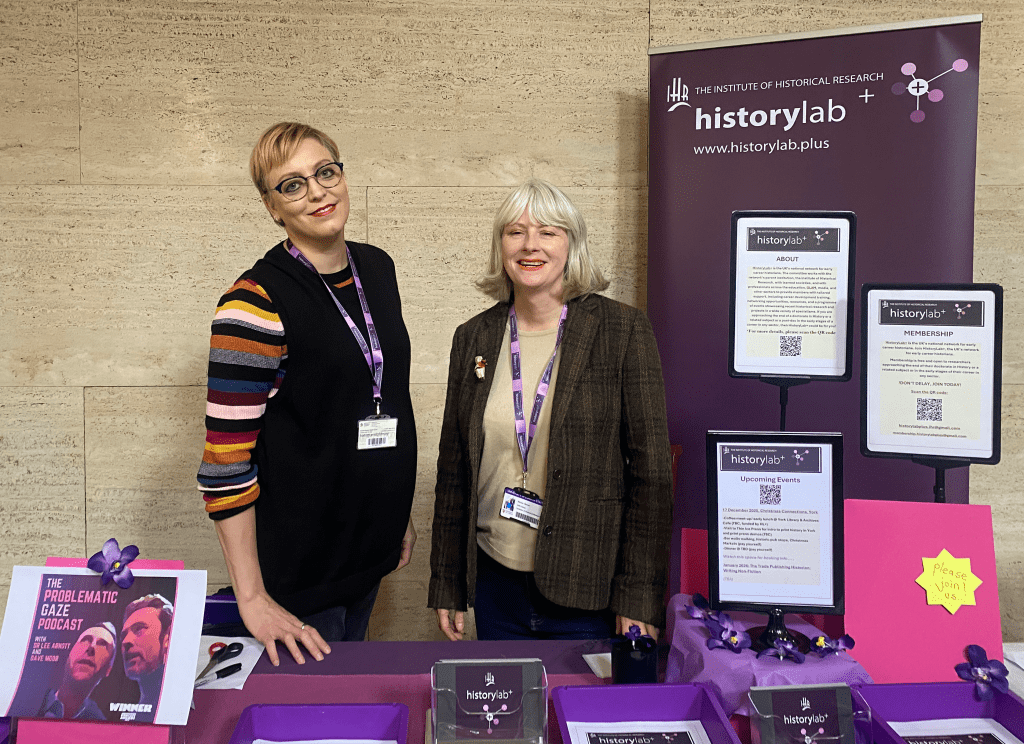
Amelia Clegg & Maxine Beuret at this year’s event
Blog coming soon . . .
BLOG: Teaching in a Time of Crisis conference, 29 May 2025
– reasons to be cheerful?
Alex Riggs Regional Ambassador, Midlands and Michael Reeve Co-Chair
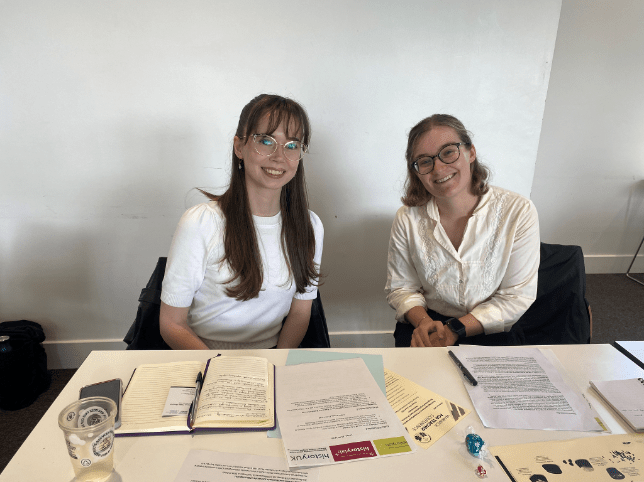
It cannot be denied that a recent conference jointly organised by HistoryLab+, HistoryLab and History UK, ‘Teaching in a Time of Crisis’, aptly described the current moment in Higher Education. Indeed, the only modification could be to describe a time of crises, given simultaneous redundancies across the sector, threats to academic freedom, and AI upending the fundamentals of academic assessment. Yet, those gathered at the University of Warwick on May 29th, 2025 showed that highly significant work is being done to address these challenges, whether by creative assessments, rethinking how we teach major topics, or using new mediums to teach about the past. From this, original and insightful teaching continues to be developed during this time of crisis.
The opening panel – organised and led by Sara Hattersley and Ollie Turner from the University of Warwick’s Academic Development Centre – provided ample space for reflection on our own pedagogical practice, while showcasing some innovative teaching techniques. Sara encouraged everyone in the room to consider how they approach teaching and the kind of academic they are by choosing a colour that represented each of us (cool blues, hot reds, and so on; much like a colour palette when you’re choosing paint), as well as the variety of chocolate we’d be in the box (and there were actual chocolates available in the room too – always appreciated!). This was an interesting way to get us all thinking about what we bring to the classroom and how we approach engaging with and supporting students. Taking over from Sara, Ollie managed to get us all out of our seats as he showcased an activity he often uses in his teaching. He asked us to get up and stand in the room at a point on a spectrum – shown on the board – that answered several questions in turn. From simple ‘yes or no’ questions to the more nuanced (strongly agree to strongly disagree, and everything in between), this exercise underlined the value of getting students out of their seats, making the classroom more dynamic and less predictable, and using the combination of questions and movement to stimulate discussion.
The next panel, Teaching History in Practice, provided an excellent showcase of the work being done in the classroom to actively respond to crisis conditions. From the University of Bristol, Josie McLellan discussed her module on the history of mental health in Britain, informed by her own practice as a psychotherapist in community mental health services. Especially insightful were contributions from three students from the module, who recounted its encouragement to rethink teleological stories of this area as continually moving towards present progress, instead a complex process of development and declension. From the same institution, James Watts discussed changing student conceptions in another way, with new forms of creative assessment. Flagging the need to reconsider the way student learning is measured in the face of AI, unsustainable staff workloads, and pressure to show the ‘value’ of the humanities to employers, Watts showed how Bristol students had made creative outputs including documentaries, websites, and podcasts alongside a 5,000-word commentary instead of a traditional dissertation. Although difficulties including inaccessible key technology (e.g. microphones, cameras), lack of well-established marking criteria, and general lack of expertise in the Humanities about the best ways of making these creative outputs suggest that there is still work to be done in making such alternatives to dissertations consistently viable, the example showed the potential of these methods to expand the range of available major History projects. Attention then turned to PGRs and ECRs through the Stuart Hall Reading Group at the University of Birmingham. Beginning with an observation about the remarkable invisibility of the Marxist cultural theorist on the campus where he had taught from 1964 to 1979, ECRs Katherine Parsons and Rita Gayle founded the Stuart Hall Reading Group as a means of building postgraduate community after the disruption of the pandemic. They astutely noted the group’s success in breaking down barriers by using a ‘neutral’ series of texts (i.e. one that nobody in the group was an expert on), and through beginning in hybrid format they provided a pathway for the workshops to be held entirely in person, with benefits for reviving a PGR/ECR community spirit post-pandemic.
The next discussion explored a creative approach to classroom learning, through game development and design. Martha McGill from the University of Warwick discussed her experience of teaching about early modern witch trials through designing a game in collaboration with students. This initiative sought to generate a game where students were genuinely involved in the game’s design, facilitated playful, bonding exercises for the class, and dealt with serious issues in an engaging way. The eventual product was a role-playing card game, Witch Hunt 1649, where players play as (fictional) members of a Scottish community that seek to avoid accusations of, and being executed for, witchcraft- this was a popular lunchtime activity at the conference! As with creative assessment, there were problems that came from less knowledge of running such modules- students had to complete more work outside of the classroom to bring the project to fruition, and knowledge inequalities meant that some student ideas had to be rejected for being based on factual inaccuracies. But a crucial takeaway from the project was how students could operate ‘on multiple levels of seriousness’, able to studiously engage with challenging topics, but also translate this into a creative and fun project that presented such information in a different way to an academic essay.
The first afternoon panel focused on an area of particular crisis for historians in 2025, the US. Martha Robinson Rhodes from Royal Holloway began with a reflection on her own experience of teaching Queer History, one of the key battlegrounds in current culture wars, at Northwestern University in Chicago. Illinois’ status as a ‘blue state’ meant that this was not a story of repression of what could be taught, but did deliver some interesting reflections on how students reacted to growing attacks on LGBT rights in the U.S. The ‘major/minor’ system allowed more students taking scientific degrees to enrol on the module, and this was perhaps reflected in many students displaying a teleological view of progress towards LGBT equality that was being disrupted by conservatives. Hence, such developments were all the more shocking. Alex Riggs also discussed changing student views from his teaching of the module From Reagan to the Rainbow Coalition at the University of Manchester. As tempting as it might be to take a presidency-focused view of our time as an ‘age of Trump’ or ‘age of polarisation’, students in Riggs’ experience were just as concerned, if not more, with trends that transcending presidents, namely the rolling back of LGBT and women’s rights, and American complicity in the atrocities of Gaza. Further panel discussion with Lydia Plath and Rebecca Stone (both based at Warwick) underlined these developments, with Stone noting that American Studies students were far less inclined to see the nation as a ‘land of freedom and Coca-Cola’ and instead taking a much more critical view of its society and, as Plath suggested, interrogating the Transatlantic comparisons that this generated far more.
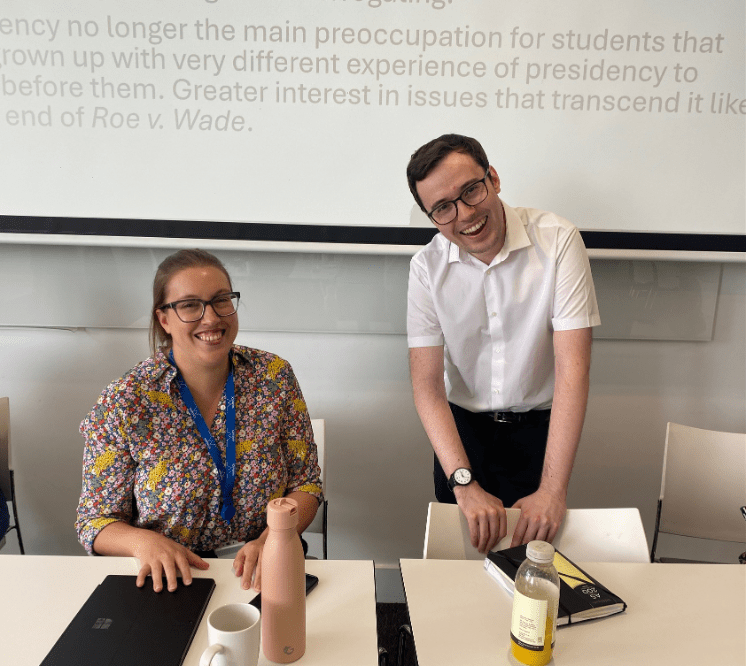
The event concluded with a focus on History education more generally. Emily Calcraft from the University of Sheffield used her expertise on interwar pacifism to highlight their focus on education as a key facet of their outlook in preventing future wars. Instead of something that should be discarded given the changing circumstances by the Second World War, it was astutely observed that their principles of creating historical empathy between nations to avoid ‘nationalistic arrogance’ was more relevant than ever in a time of escalating international tensions. The final paper interrogated the actual practice of current historical education using David Manning’s on the ground experience of teaching Tudor History at A-Level. Despite the shaping curricula in recent decades by Thatcher Education Secretary Keith Joseph’s call for history teaching to focus on ‘key evidence’ in support of a shared history of Britain as a land of liberty, the quality of this evidence was found to be sorely lacking. In particular, outdated historiographical examples leave students engaging with work long left behind by historiographical nuance, but more convenient to government narratives- startlingly, only one historical text written since 2010 featured in recent exams.
Overall then, Teaching in a Time of Crisis was a day putting much more emphasis on teaching than crisis. Although the devastating redundancies and lack of opportunities in the sector, threats of AI, and precarious position of academic freedom were never far away from the surface, the day underscored the outstanding work being done to make higher education teaching just, accessible, and innovative. Perhaps the overall lesson was that even in times of crisis, there is still plenty of opportunity for historians to build a better HE system through their work.
Blog | Newsletter | Past Events | Media | CFPs | Opportunities & External Links
 History Lab Plus